
The Péter Magyar Phenomenon: A New Political Model or a Historical Exception?

Botuar nga Flaka
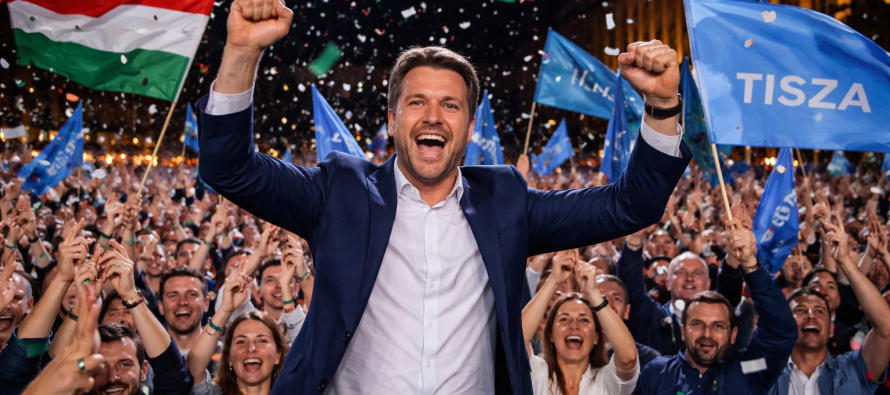
The victory of Péter Magyar over Viktor Orbán is not merely a rotation of power. It represents a rare rupture in a consolidated political system that, for 16 years, had built a strong architecture of control over institutions, media, and the electorate. In this sense, Magyar’s story is not only Hungarian—it is a case study on a global scale, writes Flaka.
The paradox lies in the fact that Magyar did not emerge from the political periphery, but from the very heart of power. A former member of the elite linked to Fidesz, he broke away in 2024 following a scandal involving a presidential pardon and suspicions of institutional manipulation. This moment was not only moral, but strategic: he used his insider knowledge of the system to challenge it publicly.
The publication of compromising materials and his denunciation of corruption gave him immediate credibility.
At a time when Hungary’s traditional opposition was fragmented and discredited, Magyar managed to channel widespread dissatisfaction into a single political figure.
The Tisza Party formally existed but was practically irrelevant until Magyar took it over in 2024.
Within just a few months, he organized mass protests with tens of thousands of citizens, built a nationwide mobilization network, won around 30% in the European Parliament elections, and ultimately succeeded in uniting voters from the left, the right, and traditional abstainers.
This extraordinary pace of growth transformed Tisza from a “phantom party” into the main alternative to the regime. In the 2026 elections, Magyar achieved a landslide victory, securing a parliamentary supermajority and bringing an end to Orbán’s era.
This was not merely a numerical victory. It was a rejection of corruption and economic stagnation, a revolt of young and urban voters, and a symbolic return toward Europe.
Record turnout and mass mobilization demonstrated that even in fortified systems, change remains possible.
His success is not accidental. It combines several key elements: an insider turning against the system—someone the public trusts because he “knows the game from within”; a simple and powerful narrative—corruption vs. justice, East vs. West; mobilization outside traditional structures, including protests, social media, and public consultations—a form of symbolic “direct democracy”; and the ability to seize the political moment, as inflation, fatigue from prolonged rule, and international isolation created the ideal conditions.
Is this an exportable model?
This is the fundamental question for Europe and beyond.
Yes—if there is deep fatigue with entrenched elites, if the traditional opposition has failed, if a figure with real (not artificial) credibility emerges, and if economic and institutional crises are tangible.
In many Balkan countries—including North Macedonia—these conditions partially exist.
No—if the system is more flexible and open (thus not requiring a “political explosion”), if there is no figure comparable to Magyar, and if institutional control is weaker than in Hungary (meaning the opposition still has traditional space to operate).
In this sense, the Magyar model is more a product of deep crisis than a universal formula.
The risk of misinterpretation
There is a temptation to see this as a simple recipe:
Leave the system, create a new party, win quickly.
But reality is more complex. Magyar was not a “pure outsider,” but a powerful insider. He benefited from a unique political moment and had a concrete scandal that ignited public outrage.
Without these elements, imitation may produce nothing more than ineffective populism.
A warning signal for political elites
The phenomenon of Péter Magyar is not just a success story. It is a warning.
It shows that prolonged rule generates strong backlash; that systemic corruption produces “explosive” political figures; and that citizens can abandon traditional parties almost overnight.
If this model is to be repeated, it will not depend on imitators—but on the failures of existing elites.
And in this sense, the real question is not:
Will there be another Péter Magyar?
But rather:
How many countries today are creating the conditions for one? Flaka


Botuar nga Flaka










2,8 miliardë euro në bixhoz: simptomë e një shoqërie në pasiguri – Çfarë flet sociologjia për fenomenin?