VMRO-DPMNE talking about corruption? Oh, please!

Botuar nga Flaka
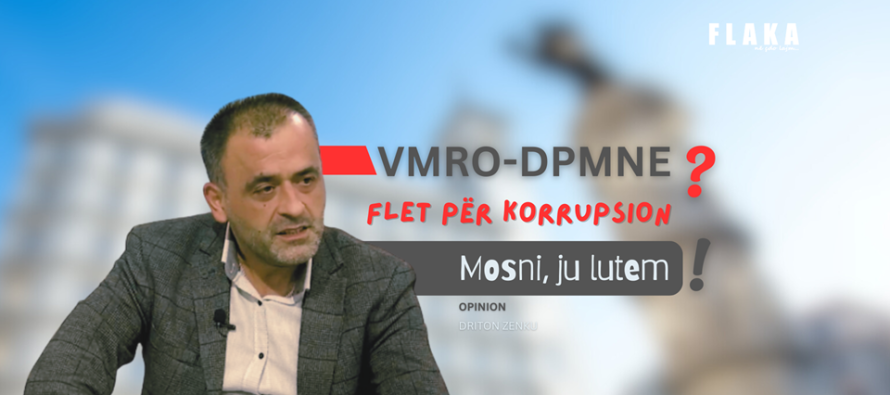
Opinion by Driton Zenku
VMRO-DPMNE lacks the moral legitimacy to speak authoritatively about corruption, due to its heavily tainted history with serious corruption scandals.
When a political actor with such a past denounces corruption in others, it is often perceived as political hypocrisy, especially in the absence of self-reflection, public apologies, or sincere distancing from compromised figures within the party.
Considering VMRO-DPMNE’s negative track record in combating corruption during its governing periods—especially from 2006 to 2017—the party’s ethical and political capacity to credibly address corruption is deeply compromised. Any such discourse requires careful analysis of political motivations and historical context of past stances and actions.
Why?
VMRO-DPMNE’s governments in the Republic of North Macedonia during 1998–2002 and 2006–2017 represent two important stages in the formation and institutionalization of corruption and state capture.
While during the first term corrupt practices were mostly opportunistic and scattered, the second period saw their transformation into a well-organized and centralized system of political control over state institutions.
1. First Term (1998–2002): Consolidation of Clientelism
After winning the 1998 parliamentary elections, VMRO-DPMNE formed a governing coalition with the Democratic Party of Albanians (DPA), promoting a market-oriented economy and Euro-Atlantic integration. However, the governance was marked by a significant lack of transparency and the institutionalization of private interests within the public sector.
Privatizations
The privatization process during this time was accelerated and lacked clear criteria, often excluding serious foreign investors. A considerable portion of social property was transferred to individuals connected to the party through non-transparent deals and deliberate undervaluation of assets. This laid the foundation for a new economic class linked to the political elite.
Scandals and Lack of Accountability
Several scandals emerged during this period involving key government figures and public administration, such as the “Makpetrol” and “Mortgage Case.” Despite preliminary investigations, no criminal proceedings concluded with clear accountability, contributing to a culture of impunity.
Consequences – Fatal for the State and Society
The government ended its mandate in a politically and socially tense climate, especially after the 2001 conflict, and with a significant legitimacy deficit. According to reports from international organizations, this period marked the consolidation of a clientelist model and political use of state institutions, albeit in a less sophisticated manner than in the years to follow.
2. Second Term (2006–2017): Institutionalized State Capture
The 2006–2017 government under the leadership of Nikola Gruevski was accompanied by numerous high-profile corruption scandals, including:
- The “Skopje 2014” project, accused of squandering hundreds of millions of euros in public funds;
- The wiretapping scandal (2015), revealing conversations about election manipulation, judicial interference, and media control;
- The escape of former Prime Minister Gruevski to avoid imprisonment for abuse of office;
- Prosecutions and investigations of dozens of top party officials by the Special Public Prosecutor’s Office (SPO).
This period marks a new phase in which corruption and political control over institutions became central components of the state’s functioning.
Institutional Control
After 2006, VMRO-DPMNE launched a systematic offensive to gain full control over all key segments of the state—including the judiciary, prosecution, public administration, police, secret services, and media. Through partisan appointments, institutional pressure, and legal manipulation, a centralized system was established in which the party dominated independent institutions.
“Skopje 2014” Project and Economic Corruption
One of the most iconic symbols of this era is the urban “Skopje 2014” project, which involved constructing dozens of monuments, public buildings, and neo-baroque structures. Marketed as a national identity initiative, the project was carried out at far higher costs than planned and was plagued by allegations of embezzlement, clientelist contracts, and public procurement corruption.
High-Profile Scandals and SPO Investigations
After 2015, the release of wiretaps by the opposition revealed massive abuses of power, including election fraud, judicial control, illegal surveillance of citizens, and unlawful financial gains. As a result, the Special Public Prosecutor’s Office (SPO) was created and began investigating a series of high-impact cases, including:
- “Titanic” – election process manipulation
- “Trajectory” – misuse of highway funds
- “TNT” – politically motivated demolition of the “Cosmos” building
- “Torture” – institutional violence against detainees
- “Talir” – illegal party financing and party headquarters construction
Instrumentalization of the Judiciary
During this period, in addition to the capture of the judiciary and media control, there was a high level of instrumentalization of the Prosecutor’s Office and Courts, selectively prosecuting or protecting political and economic figures. Investigations into opposition officials often progressed quickly, while cases involving ruling party members were delayed or closed.
So What?
VMRO-DPMNE’s governments from 1998–2002 and 2006–2017 represent two phases in the evolution of a deeply corrupt and captured state system. In the first phase, the foundations were laid for a model where private and political interests interfered in state decision-making without any functional mechanisms for oversight or accountability. In the second phase, this model became more sophisticated and institutionalized to the extent that it undermined the rule of law and seriously threatened the country’s democratic prospects.
This historical development of state capture calls for serious reflection on public institution reform, judicial independence, political accountability, and the cultivation of a democratic culture that places the citizen and the law above party interests.
Party Headquarters Construction – The White Palace – A Symbol of State Capture
During 2006–2017, VMRO-DPMNE became the most dominant political force in North Macedonia. During this time, the party constructed a grand central headquarters in Skopje—a building that quickly became a symbol of political influence, corruption, and abuse of public assets.
VMRO-DPMNE’s Return to Power – Third Term
VMRO-DPMNE returned to power in the 2024 parliamentary elections, now led by Hristijan Mickoski. In December 2017, he succeeded Nikola Gruevski as party leader. Between 2015 and 2017, Mickoski served as energy adviser to Prime Ministers Gruevski and Emil Dimitriev. In 2016, he was appointed director of the State Energy Production Company (ELEM).
The current Prime Minister and VMRO-DPMNE leader, Hristijan Mickoski, owns or is connected to family businesses in the hydroelectric sector. At the same time, he has created a new Ministry for Energy, Mining, and Mineral Resources—raising serious concerns about conflict of interest, state capture, and abuse of power for personal or family gain.
1. Conflict of Interest
If a state leader owns, controls, or has direct ties to businesses in a certain sector and creates or controls institutions regulating that same sector, it constitutes a clear conflict of interest.
Creating a ministry that directly oversees a field in which he (or his family) holds economic interests gives him the opportunity to influence regulations, licenses, subsidies, and policies in ways that may benefit those businesses.
2. State Capture
This is a classic example of state capture, where public institutions are created or controlled to protect or advance the private interests of those in power instead of serving the public good.
3. Potential for Systemic Corruption
By controlling energy policy and key natural resources through a dedicated ministry, the prime minister creates a structure to channel investments, public contracts, and licenses potentially toward affiliated or family-related businesses.
Institutional and Public Risks:
- Loss of public trust in institutions perceived as captured for narrow interests;
- Undermining of fair competition in the energy sector;
- High risk of elite corruption, where the rule of law no longer applies equally;
- Destruction of transparency and democratic oversight of natural resources.
Creating a dedicated ministry in a sector where the head of government has direct private interests is a red flag for democracy, the rule of law, and public accountability. Flaka


Botuar nga Flaka










2,8 miliardë euro në bixhoz: simptomë e një shoqërie në pasiguri – Çfarë flet sociologjia për fenomenin?